
Breast pumping is often discussed not only as a way to feed a baby, but also as a potential aid for weight loss after giving birth to a newborn. Many new mothers hear that pumping burns calories (weight loss factor),, boosts metabolism, and helps the body recover faster after pregnancy. This leads to an important question: does pumping actually help with weight loss, or is the effect overstated?
To answer this accurately, it’s important to understand how lactation, how the body distributes energy, what pumping actually does inside the body,, and how post delivery weight loss really works.
How Pumping Affects the Body?
Pumping breast milk is part of the lactation process. Whether milk is removed by breastfeeding or pumping, the body responds almost in the same way.. Producing breast milk requires energy, and that energy comes from 1.) calories stored in the body, 2.) calories from food.
On average, milk production requires approximately 300–500 calories per day, depending on milk volume, body size, and individual metabolism. This is why lactating women often feel hungrier and are advised to eat more nutrient-dense foods rather than restricting calories.
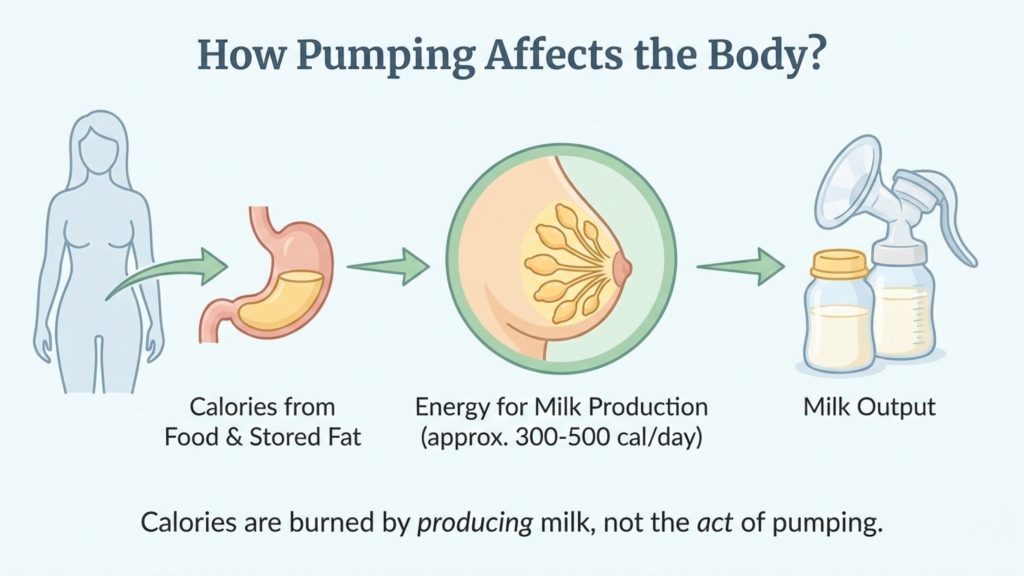
It’s important to be clear : Calories are burned from milk production, not from the act of pumping itself. Pumping does not burn calories like exercise does; it simply assists the body to aid in milk removal so the body continues to produce more milk.
Pumping vs. Breastfeeding: Is There a Difference for Weight Loss?
From a weight-loss perspective, pumping and direct breastfeeding are metabolically similar. The body doesn’t know the difference between how the milk is removed—the body responds to the demand for more milk needed..
What matters most is:
- Total milk production over time
- Hormone signals that trigger lactation
- Overall energy balance
Some women only pump their milk, others women only breastfeed, and many do a combination of both. None of these methods guarantee weight loss, but both increase daily calories that are burned, compared to not breastfeeding at all.
Why Do Some Women Lose Weight While Pumping?
Many women notice gradual weight loss while pumping or breastfeeding, especially in the first six to twelve months after giving birth. This often leads to the belief that pumping directly causes weight loss.
But here is the facts, weight changes during this time are influenced by factors several working together:
- Increased calorie burning from milk production
- Hormone changes after pregnancy
- Fluid shifts and post delivery recovery
- Changes in the mother’s daily routine and activity
When calorie intake roughly matches milk-production needs, fat stores accumulated during pregnancy may be used up gradually. This is a slow process, not a quick fat-burning effect.
Why Pumping Does Not Guarantee Weight Loss?
Even though more calories are burned after while pumping,, many women do not lose weight while pumping—and some even gain weight. This can be confusing and frustrating, but it can be easily explained.
Lactation hormones, like prolactin, can increase appetite and promote energy storage.. The body is wired to protect milk supply, sometimes allowing energy storage to trump fat loss. On top of that, poor sleep, stress, and limited recovery time can increase cortisol levels (stress hormone), which may slow weight loss or trigger the body to hold on to fat..
This is why pumping should not be viewed as a weight-loss strategy, even though it increases the burning of calories..
Does Pumping Target Belly Fat?
There is no evidence that pumping targets belly fat or causes localized fat loss. Fat loss occurs based on diet and lifestyle habits, hormone and energy balance.
Post delivery belly changes—such as a softer belly or slower waist reduction—are often related to weakened connective tissue, muscle separation, and hormonal changes, not simply fat storage. Pumping does not directly affect these structural factors.
When Pumping May Indirectly Support Weight Loss?
While pumping is not a weight-loss tool, it can indirectly support healthier postpartum weight changes under the right conditions. For some women, pumping encourages:
- More regular eating mealtimes
- Increased intake of water and other fluids
- An increased attention to the body’s requirements for good health
- Personal motivation to focus on recovery and health
When combined with a whole food, primarily plant-based diet, consistent stretching and body movement, 7 to 8 hours of daily sleep, and stress management, pumping can be part of a lifestyle that promotes gradual, healthy weight loss.
Important Nutritional Considerations
One common mistake is under-eating while pumping in an attempt to accelerate weight loss. This can backfire by:
- Reducing milk supply
- Increasing fatigue and food cravings
- Slowing metabolism
Functional medicine encourages lactating women to focus on whole food nutrition rather than dietary restriction. Weight loss, if it occurs, should be gradual and take a back seat to recovery and milk production.
A Natural Medicine Post Delivery Model
Post delivery weight loss is not straight forward, and it is not only about calories. The body is healing from pregnancy, adjusting hormonally, and supporting another human being. Expecting pumping alone to produce significant or rapid weight loss places undue pressure on an already demanding part of the life cycle.
From a natural medicine viewpoint, pumping is best viewed as a nutritional and caregiving function, not a fitness intervention.
Conclusion: Does Pumping Help With Weight Loss?
Pumping can increase daily calorie burning because producing breast milk requires energy. However, pumping itself does not directly cause weight loss, and results vary widely between individuals.
Some women lose weight gradually while pumping, others maintain their weight, and some gain weight—often due to hormonal, nutritional, and lifestyle factors. Pumping should never be relied upon as a primary weight-loss strategy.
The takeaway is this: pumping may support gradual post delivery weight loss, but it is not a guaranteed or a specific method for weight loss. However, with all of the considerations required for healthy pumping, weight loss is possible with pumping or breastfeeding.