
SIBO
High Baseline Hydrogen on a SIBO Breath Test: What Does It Mean?
Written by Dr. James Krystosik · Published September 28, 2026
Functional Medicine Physician, Chiropractor, Author, Podcast Host · In practice since 1986
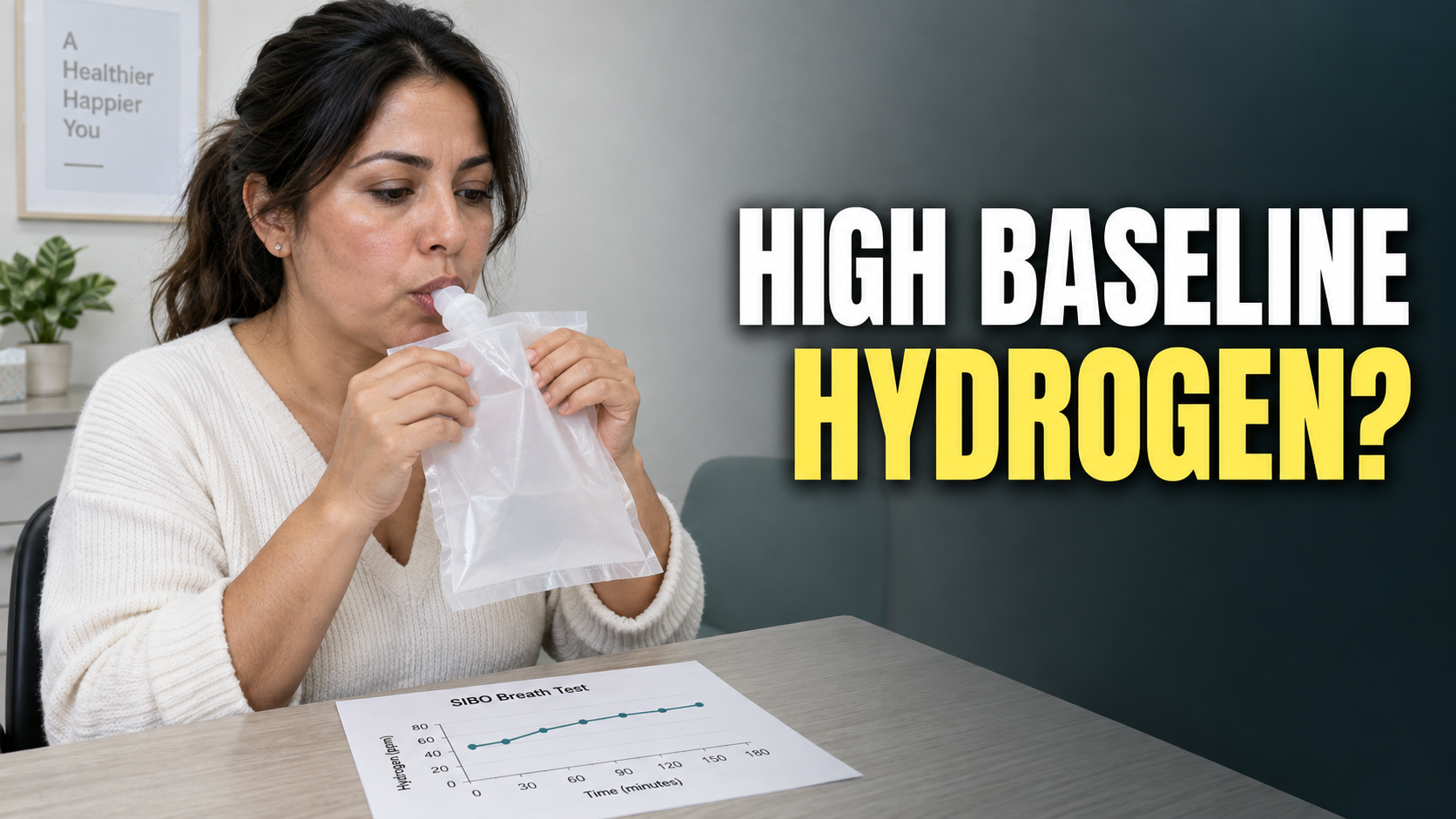
Quick answer: High baseline hydrogen means your hydrogen level was already elevated before you drank the test sugar. It may reflect preparation problems, fermentation in the mouth, slow transit or constipation, or a real digestive pattern. By itself, it doesn't give me a clean SIBO diagnosis.
Let's say you did everything—or you thought you did everything—right. You followed the diet, fasted overnight, collected the first sample, and then saw a surprisingly high hydrogen number before the test had really begun.
That first number is the baseline. It is supposed to show the gases in your breath before lactulose or glucose is introduced. When it starts high, interpreting the rest of the curve gets messy.
I don't look at that result and immediately say, “There it is. SIBO.” I slow down and ask why the starting line wasn't low.
What counts as high baseline hydrogen?
You'll see different cutoffs across laboratories and publications. A baseline hydrogen level over 20 parts per million is often treated as high or potentially uninterpretable, but some protocols use a lower threshold or apply additional rules.
That variation is exactly why I use the laboratory's method and report rather than reading one number in isolation.
For a conventional positive hydrogen pattern, current guidance commonly looks for a rise of at least 20 parts per million above baseline within 90 minutes. If the baseline itself is already elevated, calculating and trusting that rise becomes more difficult.
The most common possibilities I consider
The preparation diet wasn't followed closely enough
Food from the previous day can continue to ferment. A person may honestly think they followed the rules but add a vegetable, seasoning, fiber product, sweetener, or “healthy” snack that wasn't allowed by that lab's protocol.
The prep diet is intentionally boring. It only lasts a short time. This isn't the moment to improve it.
The fast was broken without realizing it
Coffee, gum, mints, flavored water, supplements, and even a splash of creamer count. I ask for specifics because “I didn't eat breakfast” doesn't always mean the fast was complete.
Oral bacteria contributed to the first sample
The mouth contains microbes too. They can ferment test substrates or residual material and affect early measurements. Newer guidance pays more attention to oral hygiene and, in some protocols, antiseptic mouth rinse.
Use only the instructions from the testing laboratory. Adding your own mouthwash step can also deviate from the validated protocol.
Slow transit or constipation is part of the picture
If material sits longer in the digestive tract, fasting may not produce the expected low baseline. Elevated methane at baseline can also be associated with constipation and intestinal methanogen overgrowth.
This is why I ask about hard stools, straining, incomplete evacuation, and laxative use before I interpret the graph.
The result may reflect ongoing fermentation—but it still needs context
A persistently high fasting value after careful preparation may be clinically meaningful. The problem is that the exact meaning isn't fully standardized. Some clinicians consider it supportive evidence; others repeat the study because the curve can't be interpreted confidently.
Honest medicine sometimes sounds like, “This result raises a question, but it doesn't answer it.”
What the baseline doesn't tell me
A high first hydrogen value doesn't tell me:
- which organisms are present;
- where the gas was produced;
- whether your symptoms are caused by that gas pattern;
- which treatment you need;
- whether an antibiotic or herbal product will help.
It certainly isn't a reason to order a pile of supplements from a social-media protocol.
Should you finish the test?
That depends on the lab protocol. Some laboratories continue and report the full curve. Others may cancel, flag, or recommend repeating the study when the baseline exceeds their threshold.
If you're testing at home, don't make up a new procedure halfway through. Complete the steps unless your kit specifically tells you to stop, record what happened, and contact the ordering clinician or laboratory.
When I consider repeating the test
I consider a repeat when:
- the prep diet or fast wasn't followed precisely;
- a medicine, supplement, recent antibiotic, or bowel cleanse may have interfered;
- sample collection or timing was unreliable;
- the lab calls the baseline uninterpretable;
- the result doesn't fit the symptoms or would lead to a major treatment decision.
Before repeating, I fix the controllable problem. Running the same test under the same conditions won't make the second report clearer.
My practical checklist before interpreting the curve
I review four layers:
- Preparation: food, fasting, medicines, supplements, smoking, exercise, and oral-hygiene instructions.
- Collection: sample quality, timing, labels, leaks, and the correct substrate dose.
- The entire graph: baseline, size and timing of the rise, methane values, and symptoms during the test.
- The patient: bowel pattern, anatomy, previous surgery, motility risks, and other possible diagnoses.
The fourth layer is the one a screenshot on the internet can't provide.
Don't confuse hydrogen with methane
Hydrogen and methane have different interpretation rules. Methane of 10 parts per million or more at any point is generally considered methane-positive and supports intestinal methanogen overgrowth. A high hydrogen baseline is a separate pattern and is more controversial.
If constipation is your main symptom, make sure methane was measured. A hydrogen-only test can miss clinically useful information.
For the full preparation walkthrough, read 11 SIBO Breath Test Prep Mistakes.
My bottom line
A high baseline hydrogen result isn't meaningless, but it isn't a diagnosis by itself. I verify the prep, look at oral and intestinal factors, read the full graph, and decide whether the test can answer the question we asked.
Sometimes the smartest next step isn't treatment. It's getting a test we can actually trust.